There is a particular kind of heartbreak that happens in animal shelters every day.
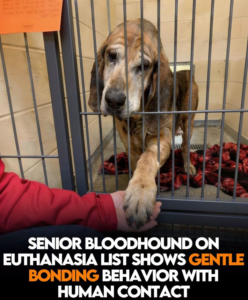
How he got there
His name isn’t part of the public record. What is known is this: he was a Bloodhound, sixteen years old, and he had lived with the same family for most of his life.
They hadn’t abandoned him carelessly. The paperwork said relocation. A move that couldn’t accommodate a sixteen-year-old dog with aging joints and increasing medical needs. The kind of situation that doesn’t have a clean villain — just circumstances, and a very old dog sitting in an intake kennel, looking at a door that his family had walked through and not come back through.
Sixteen years.
For a Bloodhound, that is an extraordinary age. It is a full life, measured in the particular way dogs measure things — in the people who fed them, the routines they memorized, the specific patch of sunlight they returned to every afternoon.
All of that was gone now.
What the staff saw
When shelter workers approached him during intake, they expected wariness.
Old dogs in new environments are often shut down — overwhelmed by unfamiliar smells and sounds, grieving in the quiet way animals grieve, turned inward and unreachable.
He wasn’t like that.
He was calm. Gentle. When a staff member sat beside him on the kennel floor, he lifted one paw — slowly, with the deliberateness of a very old animal that has learned to move carefully — and placed it on their hand.
Just that. A paw on a hand.
Shelter workers have a word for it. Affiliative behavior. The technical language for what happens when an animal reaches toward a human for connection rather than away from them.
In plain language: he was asking to be held. He was asking not to be alone.
What the veterinary notes said
The assessment was thorough and honest.
Advanced age. Reduced mobility. Joint stiffness consistent with canine arthritis at sixteen years. Physical frailty that comes not from neglect but from the simple accumulation of years. A body that had carried a life for a long time and was showing it.
He would need ongoing pain management. Mobility support. The kind of daily care that costs time and resources and the particular patience required to look after something that is slowing down.
He was not, by any standard, an easy placement.
What the system said
Shelter capacity is not an abstraction.
It is a real number — beds, kennels, staff hours, veterinary budgets — that gets reached and then exceeded. When it is exceeded, decisions get made. They are not made cruelly. They are made by people who went into animal welfare because they love animals, and who have learned to live with the distance between what they want to do and what they can do.
For senior dogs, that distance is widest.
Puppies and young dogs move through shelters. They are adopted quickly, their futures stretching out ahead of them. Senior dogs — animals at the end of their lives, animals with medical needs, animals whose time is measured in months rather than years — they stay.
And when they stay long enough, the math becomes unavoidable.
He was sixteen. He had arrived with medical needs. The shelter was full.
Euthanasia consideration was noted in his file.
The paw
What happens next in these cases varies.
Sometimes nothing happens. Sometimes a post circulates, a volunteer shares a photograph, a rescue organization sees it in time. Sometimes someone drives three hours because they couldn’t stop thinking about an old dog they saw on a shelter’s social media page.
What is constant — what is true in every version of this story — is the moment that started it.
An old Bloodhound, sixteen years old, surrendered by the only family he had ever known, sitting in a kennel that smelled like strangers. A shelter worker sitting beside him on the floor.
A paw, placed gently on a human hand.
Not a demand. Not a performance. Just a very old dog, doing the only thing he knew how to do when he was afraid.
Reaching toward someone.
What this story asks
Senior dogs are the shelter system’s hardest problem.
They arrive with histories. With needs. With bodies that require more than a young animal requires. They don’t photograph as well. They don’t attract the same volume of adoption inquiries. They cost more to maintain and they have, by definition, less time ahead of them.
What they have — what this dog had, sitting in that kennel with his paw on a stranger’s hand — is the accumulated softness of a long life spent with people. The patience. The gentleness. The complete absence of aggression or unpredictability that comes from an animal who has nothing left to prove.
Old dogs don’t need to be trained. They don’t need to be socialized. They need a quiet house and someone who will sit with them on the floor and let them place a paw on a hand.
They need someone to reach back.